Laser scanning technologies allow engineers and contractors to reduce risks, cut costs, and expedite the design and creation of projects.
How 3D Scanning Works
You might think that 3D scanning is complex, but quite the opposite, it’s remarkably straightforward. Instead of using cameras to capture a virtual image, precise laser scanners are deployed to capture highly detailed spatial images of objects. This relatively advanced technology captures the forms of physical objects with high accuracy and digitally transforms them into three-dimensional textured models, plans, and facades. These objects can now also be replicated using 3D printers with data obtained from the scanner.
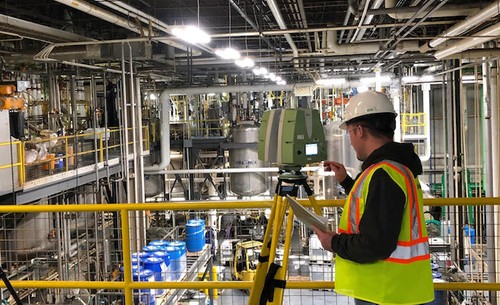
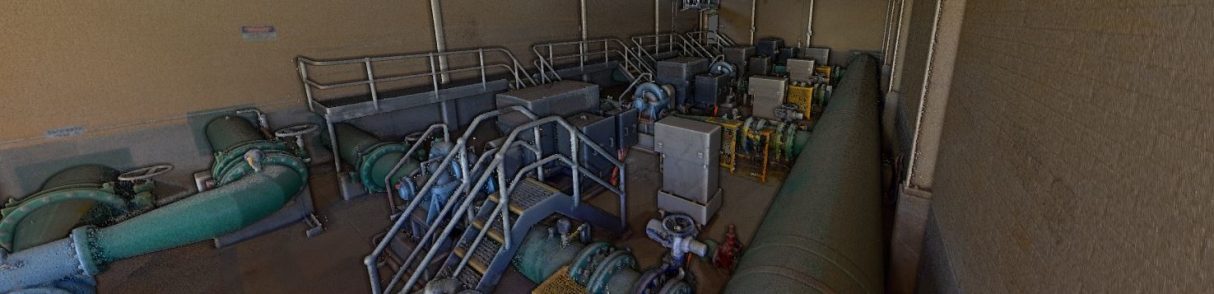
Unlike other methods that capture individual points one by one, a 3D laser scanner captures a large number of details from the entire scene. This is because the device records approximately one million points per second, rotating and emitting minuscule points that bounce back to measure any physical space. This, in turn, creates a real representation of what’s there in the form of dots (or a point cloud). The more scans that are performed, the more overlap is achieved, as well as higher accuracy and point density. This allows us to create a design straight from a point or point cloud, and then we incorporate levels of reality modeling. Among other tools, these can include photographs or UAV videos, and when all of this is overlaid onto the scan, an interactive model is revealed with accuracy down to a few millimeters.
Data-Intensive Analysis
The analysis of extensive datasets collected through laser scanning used to pose a challenge due to the massive volume of acquired data, but the situation has significantly improved in recent years. New software enables engineers to check the entire project for errors in significantly less time than without this technology. Moreover, essential data can be collected through various methods: from a distance, on the ground, or even in unfavorable weather conditions. Subsequently, the gathered data can be viewed in a 3D space at the office, allowing project-involved clients to obtain a real view of the site without the actual necessity of physically visiting the area. Images derived from this data are precise, measurable, and editable.
Advantages of Laser Scanning
- An advantage of laser scanning is the ability to create a user-friendly browser-based solution that allows users to view scans without any specialized software or CAD knowledge.
- Laser scanning data can be used for clash detection, providing confidence that your design will fit within the proposed area.
- Point clouds can be converted into 3D models, intelligent or non-intelligent, in various output formats.
- Efficient maintenance and integrity assurance through planned utilization of existing data.
Project results are tailored to client needs. Promaspect can provide a point cloud of the scanned project, allowing the client to view and measure objects. We can also provide a 3D model, enabling the client to easily design and incorporate components. The ability to customize outcomes allows clients to contract only the services needed for their specific project.
Whether documenting existing conditions, upgrading pipelines, renovating a building, or designing a new bridge, 3D laser scanning will save you time and money.